

Going into 2026, use of assisted coding tools is going to dramatically affect the way we manage software projects. That’s because we are trying to manage 2026 engineering velocity with 2010 project management tools.
Our entire software development lifecycle (Agile, Scrum, Jira, etc.) was built around the constraint: Writing code is slow and expensive. Because implementation was slow, we built processes to “measure twice, cut once.” We groom backlogs and debate requirements because we can’t afford to waste engineering cycles.
But that constraint is going away. AI coding is inverting the equation. Writing code is now cheap and instant. Code velocity is going exponential, but process velocity is linear. There’s a new risk: The Shadow Codebase. Features are implemented faster than tickets can be written. Documentation is left behind, creating instant legacy code. Pull requests turn into 500 file monsters that are impossible to review effectively (this is becoming a real problem for open source projects).
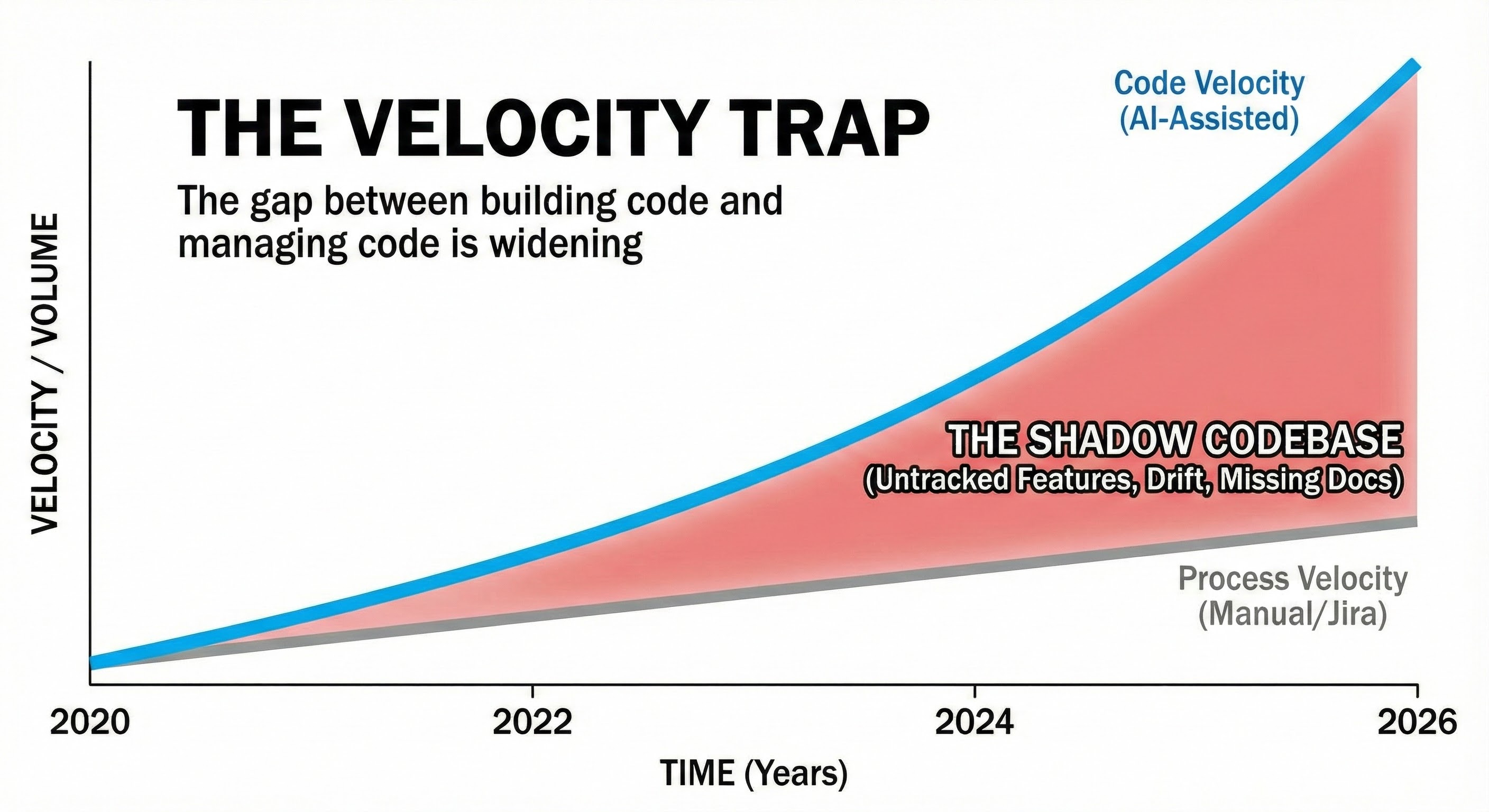
The danger is that the scope and amount of code explodes, and the “admin tax” of tracking it will become unmanageable. This isn’t just a large team issue. It will kill small teams and startups too. I started thinking about this problem because I encountered it with my own solo projects. I was finding myself adding multiple features at a time with parallel agents because it was so easy to start a refactor or new feature. I lost track of which features had been developed and what I had tested. I was having so much fun getting code written for me that I became a project manager’s worst nightmare.
When velocity jumps 10x, the project management admin work becomes impossible, and the project will descend into chaos.
The solution isn’t to slow down the developers or ban AI. I think we need to invert the management model. We need to move from a Prescriptive SDLC (Plan to Code) to a Descriptive SDLC (Code to Plan). We need “Reverse Project Management.”
I’ve been experimenting with new toolchains that integrate seamlessly into the AI development environment:
AI that watches the code in real-time and alerts the developer when they drift from the ticket’s intent.
Tools that auto-generate tickets, bug reports, and documentation based on the code that was just written.
AI assisted standups act as a “Fractional PM.” The tools track what developers are actually working on, both in terms of drift, and the tasks that were already planned. This brings transparency to the work the entire team is actually doing.
I’m already seeing the benefits. I can still get code written at superhuman speed, but I also keep control of the project features and status.
If we want to survive the era of AI coding without drowning in technical debt and out of control projects, we have to stop expecting developers to be data entry clerks for Jira. We still need to plan software development with requirements analysis and architecture, but we need new processes and tools to make sure the project management can keep up with the increased code-writing velocity.
This resonates with my non coding process: "AI that watches the code in real-time and alerts the developer when they drift from the ticket’s intent." My UUP protocol is in continuous adversarial mode (not mean just persistent in challenging my ideas) as I think through with Claude what I want to say and do. So, like this code reference, my AI tells me I am no longer making sense relative to a former agreed upon way to address an issue and I have to come up with a rational reason or accept that I have to bend on that point. I am better with AI as long as I take the lead.